Showing posts with label vox. Show all posts

Friday, May 5, 2017

Hospital charges and how to dispute them

Elizabeth Rosenthal is the author of the book "An American Sickness". She describes the evolution of healthcare into the twisted business it is today. She also discusses in this article the tricks hospitals use to jack up your bill. The article also gives some pointers in ways to dispute your bill.

Tips:

  • Insist on the consent forms that you are willing to pay as long as charges are in network
  • Get an itemized listing of charges (there are often lots of errors in bills or charges for services that were never provided)
  • Remember that you can negotiate your bills
  • Avoid private rooms
  • Refuse unnecessary treatment or equipment
  • Identify anyone who comes to your bedside (hospitals or physicians will often charge for these "checkups" and "visits")

Friday, March 31, 2017

Learning how to challenge fake news

Vox featured an author who teaches fifth graders. This teacher showed her students how to investigate whether or not what an article was saying could be backed up by objective evidence. They quickly became very accomplished fact-checkers!

Here was a summary of the plan.

I was determined to change the way I help my students critically analyze the information they were finding on the internet

To make sure I wouldn’t have any student in the same situation as Andy ever again, I started asking my students to examine seven different elements of a news article. If the information checks out on each of these points, it has a high likelihood of being accurate. Still, passing the test is not a guarantee that it’s fact.
  1. Copyright: I always ask students to check the bottom of the webpage to see if the information has been submitted for ownership.
  2. Verification with multiple sources: Students must double check the information on a few different web pages. Like in a trial, the more corroborating witnesses, the more likely the truth will be discovered.
  3. Credibility of source, such as between History.com versus a random unknown source: I tell them to check if the source has been recently created. Sources that have been around for a while can show reliability over time and be tested by hindsight, whereas recently created sources don’t carry much of a track record.
  4. Date published: I always ask them to check how recently the page was updated to see how current the information is and whether anything has changed.
  5. Author's expertise and background with the subject: Students should check if the author is someone who has dedicated time and effort to learning this subject. For example, a university professor typically has increased credibility versus a hobbyist.
  6. Does it match your prior knowledge: I ask them if the information matches up with what they have learned before
  7. Does it seem realistic: I tell students to use their common sense. Does something seem authentic or probable?

Here is a link to the full article:  Vox: I taught my 5th-graders how to spot fake news

Friday, October 28, 2016

The Apple approach to innovation

Vox has an article talking about the release yesterday of the Touch Bar for Apple MacBook Pro laptops. It's a significant advance. They explain why it succeeded for Apple despite the fact that this particular innovation had been tried before by other manufacturers but failed.

Apple controls its products tightly. This approach allows it to approach innovation very differently:

In contrast, Apple controls the entire “stack” for its products. It manufactures the hardware, writes a lot of the software, and even makes some of its own chips. This makes it hard to achieve a large market share, since it’s difficult for one company to serve a lot of different kinds of customers. But the example of the Touch Bar shows that the Apple approach still has some distinct advantages.
It’s hard to imagine anyone other than Apple successfully pulling off an ambitious innovation like the Touch Bar because it requires simultaneous investments on both the hardware and software sides of the business.
Apple’s ability to make dramatic changes to its platforms has been an important source of strength for the company. And it’s a big reason that two of Apple’s chief competitors — Google and Microsoft — have increasingly aped Apple’s business model in recent years.
Here is more on why Apple can lead far more successfully than its competitors despite having much less market share:

A feature like Touch Bar or Adaptive Keyboard is only going to succeed if it becomes a platform-wide standard. And on a decentralized platform like Windows, that creates a chicken-and-egg problem: Applications developers are only going to put in the effort to support it if it’s available on a lot of laptops. But laptop makers are only going to offer it if there’s a lot of application support.
This is a particularly severe problem in the Windows PC world precisely because the PC market is so competitive. The hardware for the Touch Bar is apparently expensive — Apple is charging $300 extra for the cheapest MacBook Pro with a Touch Bar compared with the entry-level MacBook Pro without it.
So if a PC maker added a Touch Bar to its laptops, it would be taking a big risk of getting undercut by competitors that skipped the Touch Bar and charged significantly less. This is probably one reason Lenovo’s adaptive keyboard was so much less impressive than the Touch Bar — the Chinese company couldn’t spend a lot on the feature and risk being priced out of the market.
Apple can guarantee that a significant percentage of their products will contain the new innovation. This allows the software makers to design products with the confidence that there will be a ready market for their work once the new innovation is finally released.

This model has been so successful for Apple that Microsoft and Google are now openly copying it. They have both ventured into producing their own hardware (Surface, Chromebooks, and the Pixel). All of this will likely lead to even more innovation in the years to come.

Here is a link to the original article:  http://www.vox.com/new-money/2016/10/27/13441068/touch-bar-apple-google

Tuesday, February 2, 2016

Some sense of size

Original post:  Dec 29, 2015

The Hubble Space Telescope has given us some of the clearest pictures yet of the wider universe. Earlier this year, NASA released an enormously detailed photo of the galaxy Andromeda. To give you some idea of just how large the photo is, NASA points out that it would take 600 HD TVs to display the image at full resolution!

The YouTube video below will help give you some small appreciation for the incredible size of our universe. An excerpt from a Vox article puts it into perspective:

As the video zooms deeper and deeper, remember that every single pinprick of light is a star — in most cases, scientists believe, a star orbited by its own planet (or planets).
Think of it this way: our Solar System is so big that we still haven't sent any spacecraftbeyond its borders. But it's replicated over and over, literally billions of times, in the Andromeda Galaxy. And Andromeda is just a single galaxy, relatively close to our Milky Way — both are part of a larger supercluster of galaxies called Laniakea.
Science can certainly be a mind-blowing experience.
Here is the link to the source article:  It's impossible to appreciate how vast the universe is. But this video will help. - Vox http://www.vox.com/2015/1/26/7915359/andromeda-galaxy-video

Monday, December 28, 2015

A new way to slice the economic pie

Original post:  Aug 25, 2015

In light of recent turmoil in the world markets, we can see how interconnected the global economy really is. Now, more than ever, it's important for us to understand how our products and services fit into the new world economy.

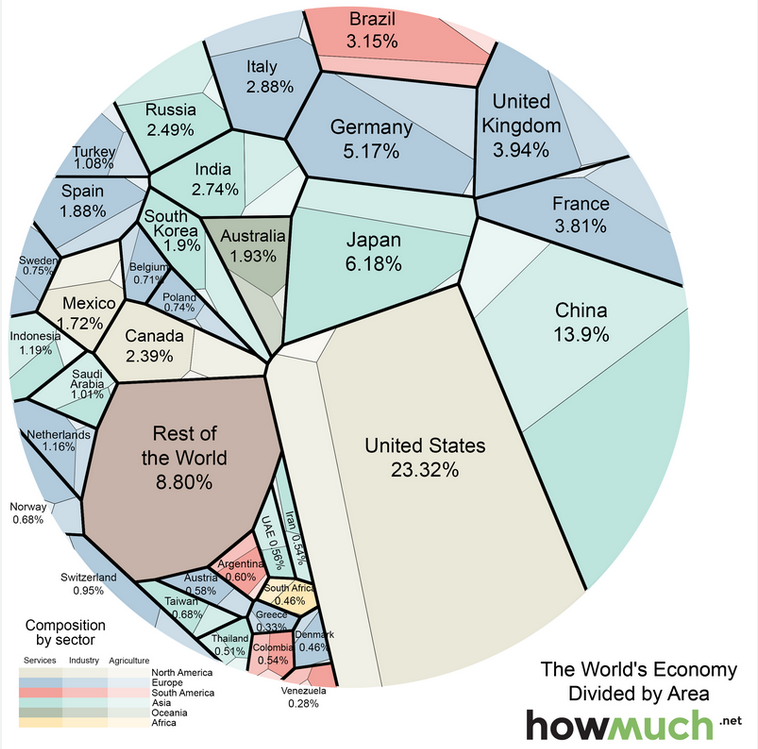
Infographics are new ways to visualize data. This particular graphic divides the global economy by country to give an idea of relative size in Gross Domestic Product (GDP--a common measure of the value of goods and services in an economy). Each slice is then further subdivided to show three different sectors within each country:  agricultural, manufacturing, and services. That view illustrates some interesting dynamics:
I am surprised by how much the US is dominated by services. I also did not realize how services are also dominant in most other countries around the world. Given how much we hear about manufacturing (particularly in China and Germany), it's interesting to note that it is still a minority of the economy in all of these major countries.

I also did not realize that Brazil's economy was larger than India, South Korea, or Russia!

Here is the link to the full article:  This striking diagram will change how you look at the world economy - Vox


A matter of scale

Original post:  Aug 21, 2015

There is a huge disparity in the geographic location of the population in the United States. If you graphed the states based on that population instead of their land mass, the resulting map would look very different.

This article in Vox shows one artist's interpretation of that map:  This is what the United States looks like if you scale states by population - Vox

California might actually be undersized considering the Census Bureau estimates that there are almost 39 million people living there!

I was actually surprised at how large both Massachusetts and New Jersey are, relatively speaking. I've also never seen a map with Hawaii larger than Alaska!

Monday, October 19, 2015

"Fixing" an innovation

Original post:  Mar 23, 2015

One common misperception of innovation is that it springs forth fully formed (like the apocryphal Venus in the Botticelli painting). In reality, many inventions require constant tinkering and improvement. Sometimes, it requires someone completely separated from the original creators to take an existing idea and transform it into a transcendent idea.
writingball.0.jpg
This photo is from the first successful attempt at some version of a typewriter. While it looks somewhat familiar, there are substantial differences compared to what you might commonly associate with the classic models.

But it had big problems. For one, the keys pressed onto the curved paper at an angle, which meant some of the letters were blurry. It also necessitated a hunt-and-peck approach to typing that made it hard to use — you could get used to a writing ball (just as you do to a QWERTY keyboard), but it was difficult to master the angled keyboard. Worse, it was hard to see what you'd typed until your document was finished. Finally, there wasn't a workable way to use a "shift" key.
Yet modern typewriters didn't really take off until 1873, when Remington produced a version of the typewriter that had a QWERTY keyboard and a shift key. Equally important, it printed sharper letters. People realized that typewriters were good not just for those with visual handicaps, but for anybody who wanted to write a clear document. Though writing-ball advocates are still fans of the device's aesthetics, the typewriter won for functionality.
By taking the original "pincushion" design and making it more useful, Remington actually paved the way for commercial success.

Here are some other examples of twists to the original invention that helped changed the future:

That'll be extra

Original post:  Mar 25, 2015

Rising healthcare costs lead the headlines. One solution that is commonly touted is to allow patients the freedom to choose. The operating theory is that if the patient is able to compare costs, they will choose the lower cost option.

There are some issues with that theory. In healthcare, cost doesn't always equal quality. If you don't commonly shop for an MRI, it's difficult to know whether the lowest cost provider is actually going to give you the service or quality that you need. There may also be time factors involved. If you have a heart attack or break a leg, chances are you can't do any comparison shopping among various hospitals.

To add even more confusion to the mix, hospitals often bill for everything. While that may seem like an exaggeration to anyone who has had to negotiate with an airline or cable company, it is not. They often offer itemized lists that include charges for individual pills of Tylenol. They might even bill you whether you took the pill or not!

In this thought experiment, Rachel Feierman imagined what would happen if restaurants billed customers like hospitals. It would certainly make you think twice about eating out:

2 dining.PNG
1 Dining billed like healthcare.PNG
Here are links to the articles explaining how she came up with the images:

Tuesday, August 11, 2015

Happy feet, no bruises

Original post:  Mar 4, 2015

Icy sidewalks and driveways can be treacherous. Given the extremely cold temperatures lately, it can be really difficult to avoid slipping and falling. Frozen ground is a terribly unforgiving surface. To minimize your risk this winter, perhaps we ought to take a page out of the penguin playbook.
happy feet.jpg
This Vox infographic helps explain why penguins waddle the way that they do. Shifting their center of gravity over their main point of contact helps reduce the odds of falling!
icy walk.PNG
Here is the link to the full article:  This is the best tip to avoid wiping out on the ice - Vox

Study smarter

Original post:  Feb 26, 2015

No matter how accomplished we may be, there are always things we need to learn. For many of us, this process can be quite painful. Fortunately, science is helping us understand the difference between effective methods and those that simply appear to be effective.

To me, the most surprising finding was that re-reading your notes is a highly inefficient way to study! While it was the most common method cited by most students, here is what the researchers actually found:

"On your first reading of something, you extract a lot of understanding. But when you do the second reading, you read with a sense of 'I know this, I know this.' So basically, you're not processing it deeply, or picking more out of it. Often, the re-reading is cursory — and it's insidious, because this gives you the illusion that you know the material very well, when in fact there are gaps."

The research found that it was much more effective to ask yourself questions or to link the information to other knowledge that you might have. Even flashcards were found to be more effective than re-reading notes.
4838276667_8d92568682_o.jpg
Here is a link to the full article detailing ways to improve your studies:  Re-reading is inefficient. Here are 8 tips for studying smarter. - Vox

Tuesday, June 16, 2015

Putting things into perspective

Original post:  Oct 22, 2014

Fear is a powerful emotion. Once unleashed, it can overwhelm our rational side and become an all-consuming beast. Today's headlines scream out warnings about potential dangers. Much of it is aimed at grabbing your attention to earn more advertising revenue. There are even some who hope to profit off our insecurities. Witness the story of a scavenger who claimed the "ebola.com" URL and wants to sell it now for $150,000!     Entrepreneur tries to sell Ebola.com for $150,000 - Telegraph
ebola.PNG

We often lack objective evidence that will help us keep some of these potential threats in perspective. This article from Vox actually ranks a number of different threats to Americans. It is interesting to see the comparison of the threats that are hyped on the nightly news compared against actual results from other "everyday" occurrences that are, in fact, much more deadly. To give just one example pulled from the article, ebola has only sickened a handful of people and resulted in one high-profile death. By contrast, a severe flu epidemic in 2004 killed 48,000! Despite the disparity, the level of alarm was far less. Some of it may be due to the lesser effects of 24 hour news networks and social media back then. Much of it is due to the relative unknowns about ebola which make it much harder to comprehend.

One other example is the fact that about 40,000 Americans are seriously injured by falling furniture in their own homes! Cases of "tip-over" caused a little less than 30 deaths last year. That makes it a much more serious threat than ebola!

This is why we write things down

Original post:  Oct 15, 2014

Nina Pham is a nurse in Texas who recently contracted Ebola after treating a patient. She was wearing full personal protective gear and knew that she was treating a highly infectious patient with the disease. How could she have been so careless?

It turns out that while there are specific procedures for treating these patients, it isn't always so easy to follow the protocols exactly. It is very complicated. There are also many sections where the directions are ambiguous or unclear. Here is an example from the actual CDC document:

ppe_removal.0.png
Each of the five sections actually has a more detailed longer section with step-by-step instructions. There are specific instructions for what to do if your hands are contaminated, but nothing about what happens if some contamination infects another part of the body. There are also two examples shown for removing personal protective equipment with no preference stated for one over the other.

An article in Vox quotes CDC director Tom Frieden acknowledging the difficulty in following the protocol:

"The care of Ebola can be done safely but it's hard to do it safely," Frieden said in his Sunday press conference. "Even an innocent slip-up can result in contamination."

There is a 49 slide PowerPoint which gives more detail. It is only a slice of what is available:

These presentations are summaries of a longer, more official set of guidance, the 2007 Guidelines for Isolation Precautions: Preventing Transmission of Infectious Agents in Healthcare Settings.
This 225-page document (145 pages without footnotes) is arguably the United States' most comprehensive guide to wearing protective health care equipment. One section, on page 52, talks about the challenges of finding the right mask:
Since procedure/isolation masks are not regulated by the FDA, there may be more variability in quality and performance than with  surgical masks. Masks come in various shapes (e.g., molded and non-molded), sizes, filtration efficiency, and method of attachment (e.g., ties, elastic, ear loops). Healthcare facilities may find that different types of masks are needed to meet individual healthcare personnel needs.
How does a hospital choose the right mask after reading that paragraph?

The article closes with a few quotes from Atul Gawande, one of the leading proponents of checklists:

Protocols can be incredibly powerful and important documents in healthcare. Atul Gawande has written extensively about the importance of checklists, and how a simple set of guidelines can go a long way. In one experiment he writes about, intensive care units who followed checklists decreased infections rates by one third in just three months.
"It's true of cardiac care, stroke treatment, H.I.V. treatment, and surgery of all kinds," Gawande writes. "It's also true of diagnosis, whether one is trying to identify cancer or infection or a heart attack. All have steps that are worth putting on a checklist and testing in routine care."
It is undeniably good that the CDC has a checklist for how to put on the protective gear needed to treat Ebola patients. It's less good, however, that the protocol is difficult to follow and leaves space for human decisionmaking — and thus space for dangerous human error.